Showing posts with label The Victoria and Albert Museum. Show all posts

Wednesday, 14 November 2012

Kids In Museums Manifesto - Part One


This week, I wanted to look more generally at London’s museums, and the way they work with the lovely ideas promoted by the Kids In Museums Manifesto. Kids In Museums is “the voice of family museum visitors across Britain” and work alongside museums to help create places which are educational, safe, fun and entertaining for all types of families and all types of child. Their website is well worth a look when choosing a museum to visit, as more often or not, the museums which have signed up to support the Kids In Museums Manifesto have a wonderful attitude to helping make your visit with your preschooler as helpful, stress free and memorable as possible. They understand that toddlers don’t use museums in the same way as other visitors and, for me, knowing the museum staff appreciate this and aren’t about to glare disapprovingly or tell you off simply because your child wants to zoom around a gallery first before settling to look at it in more detail (a habit noted by many educational specialists as being essential to ensuring a toddler feels safe in a space, which is necessary to provide an effective learning experience), or because your child wants to chat to the gallery steward in a slightly louder voice than the average visitor.

So, below are the first 5 rules of the manifesto, and I have shared my thoughts on which museums fulfil them exceptionally well, and which would certainly be graded with a ‘could try harder’!

1. Tell tales together with children and families. Share each other’s stories. Listen. Families and museums each have their own expertise.
To really get a sense of this in the most literal sense, look for museums which are running events during the weekends or school holidays. Recently, The Natural History Museum hosted a half term event called “The Campsite”; and one activity encouraged children to share their stories through writing, drawing or narration. These stories were then stored away for posterity, and the pleased look on small people’s faces as their carefully coloured in drawings were put safely away was lovely. On days when there are no special events, make sure you communicate with your preschooler, and encourage them to chat with the gallery stewards. As a museum volunteer myself, I really enjoy talking with young visitors about our favourite exhibit, or sharing stories about our experience in the museum. With the exception of one steward at the National Gallery (more on him another week) I have yet to meet a museum employee or volunteer who hasn’t been brilliant at listening and talking with Yiannis.


2. Be welcoming and greet each visitor. Tell visitors what they can do at the door, don’t pin up a list of things they can’t.
Children like boundaries; they feel safe and secure knowing what they can and can’t do. Parents or carers with children similarly like boundaries – very little is as exhausted at constantly hissing at your preschooler “come back...I don’t know if we’re allowed in there!” Removing the uncertainty makes for a much more relaxing atmosphere. However, museums, if we are doing something naughty, like letting our toddler take a photo of something, please let us know politely. Telling us off gets our backs up, decreases the likelihood of spending in the gift shop and also, no toddler is able to frame a picture well enough to endanger copyright (although I do understand it’s frustrating if the flash can damage the object).

3. Play the generation game...Conversations between generations should be at the heart of what you do.
Chatting with your preschooler has been a strong feature in my previous posts. When museums can encourage this, either through set activities or ensuring the displays are visible to the smallest visitor, the visit is always far more entertaining and educational for you both. Also, please do leave feedback with the museum on how you found their provisions for preschoolers – only with an open conversation between carers, parents and staff can museums improve. The Natural History Museum and the Foundling Museum stand out as being particularly good at inviting and reacting to feedback.


4. Invite teenagers into your gang. Provide a place for them to hang out. Set up youth panels. Ask them how they want to be involved. Museums can lead the way in letting people know the contribution teenagers make.
Well, admittedly, this is one I don’t have any firsthand experience of, since being a teenager myself; but I do feel preschoolers and teenagers are sometimes viewed in the same bracket as being the more difficult non adult audience to cater for. A museum which is working well and providing for teenagers is likely to be a very friendly and open place, and willing to help provide a lovely day out for your preschooler. The Science Museum, the V and A and the Natural History Museum are all well versed at providing for a large range of visitors.

5.  Be flexible in your activities, events and family tickets. Families come in all shapes and sizes. Design your pricing and programmes with all sorts of families in mind.
Again, the big museums in South Kensington are particularly good at ensuring a range of activities and events, including those for toddlers and preschoolers. Others, such as The British Museum, whilst providing a number of activities during the school holidays, fail to look to the under 5s audience, which made Yiannis very sad. Furthermore, when we visited in February half term, to find a huge range of fascinating make-and-do events all around the central hall, we were told Yiannis was not allowed to take part, as he was only 2. This was almost the most unhelpful thing I have ever experienced in a museum (apart from that man in the National Gallery). Museums – just let the under 5s have a go! You don’t have to display their handiwork, but for goodness sake, just let them have a go at drawing!


Next week, I will look at the next 5 rules, and I may well tell the tale of the man in the National Gallery...

Wednesday, 31 October 2012

The Victoria and Albert Museum


Museum: The Victoria and Albert Museum

Address: Cromwell Road, South Kensington, SW7 2RL

Telephone: (0)20 7942 2000

Opening Hours: 10:00 – 17:45 daily. 10:00 – 22:00 Fridays. Closed 24th – 26th December.

Website: http://www.vam.ac.uk

Pushchair Friendly Routes: Unfortunately, no easy one! Taking the Circle or District Line to South Kensington does cuts down on the number of stairs you have to tackle. However, after the tube you still have to tackle several stairs. Take the underground walkway from South Kensington station if you want to recover from the platform stairs before the next few. Or head up out the station to get all the stairs out the way, and reward yourself with the gorgeous five minute walk above ground. Parking the pushchair in the museum is a further performance, but well worth it – trying to navigate around marble statues is not fun with a buggy!

The V and A is often thought of as a more “grown up” museum, with exhibitions on fashion and design. However,  it is a treasure trove for pre-schoolers, as long as you are willing to be a very active part of their museum experience. It’s not a museum where engagements for pre-schoolers are handed to you, but it can be utterly magical with a bit of thought and imagination between you and your little one! Also, the Natural History Museum and Science Museum are absolutely packed during half term week, so this slightly less obvious choice is the ideal way to escape the stress of the crowds. 

Although the V and A is not as well known for children’s activities as it’s South Kensington neighbours, it does host a range of interesting, themed children’s workshops and days. Most of these are aimed at those five years old and above;  however for the littler visitors they do offer an Agent Animal bag. It is a lovely rucksack, just the right size for your toddler (although inevitably you’ll be the one who carries it), with a selection of activities inside based around the various representations of animals in the museum. It’s a wonderful idea, and perhaps for a more patient, or shyer, toddler it would be ideal. For my little museum companion, Yiannis, the V and A is filled to the brim of fascinating, bizarre and utterly unique objects, all of which must be seen. This means tackling the museum’s corridors in a rather excited fashion, and the time it took me to open the rucksack and try to explain the activities inside was time Yiannis much preferred to spend zipping round, actually seeing things. If you or your little person prefer a bit more structure to the visit, the Agent Animal bag is brilliant; however if you are willing to go a bit rogue and explore the museum together at your own pace, I would recommend that.

I had been a little hesitant to try the V and A with a toddler, and after the abject failure of the Agent Animal bag in Yiannis’ eyes, I was slightly concerned this was going to be a visit not to repeat. However, as we stepped into the beautiful entrance hall, our eyes were caught by the fabulous Rotunda chandelier. Yiannis asked me what it was. I had to admit that I had no idea, although I thought it was very lovely. Yiannis looked at me, and informed me “well, it’s an octopus.”  


This set the tone for the visit, and provided hours of fun, as well as an excellent starting point for discussion about the art. As we discovered the museum, our route lead by Yiannis, I would ask him “which is the saddest statue? Why do you think he is sad?”, “Which key is the biggest?”, “Which picture would you like to live in? Why that one?”. Hearing his thoughts, and unique take, on these masterpieces was fascinating and gave us a great deal to chat about, think about, and laugh about.  This game was further enhanced by the fact very little in the V and A is in display cases, and those which are tend to be in cases where the glass reaches from the floor to the ceiling. This meant there wasn’t anything Yiannis couldn’t see, and the accessibility of the displays heightened his engagement with and enjoyment of the space.

One of the aspects of museum life which the Kids In Museums manifesto emphasises is for staff not to “shhhh” children. I believe in this completely. Museums are huge and daunting, as well as being fantastic. They are places for discovery, and this can only be done when a child feels comfortable and secure in a place; being persistently hissed at is not at all helpful in creating this atmosphere. The staff at the V and A are wonderful at letting children have this freedom to explore, without allowing the sound level to become too mad. They joined in with our game, asking Yiannis questions about his choices, and making him feel, quite rightly, that his take on the art was as valid, important and interesting as the next person’s.

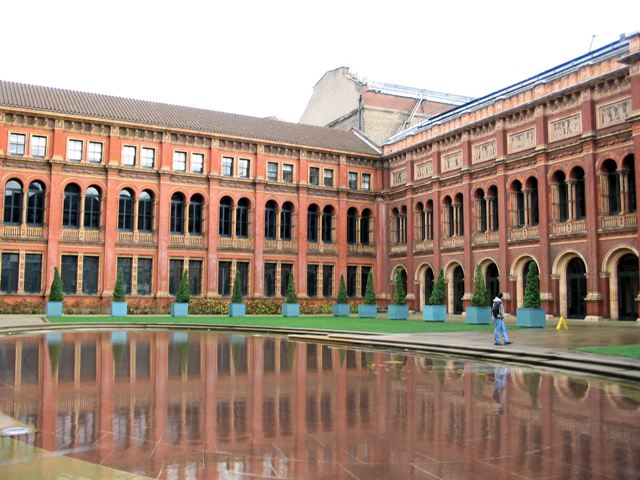
The V and A doesn’t give away it's secrets in it's name, but the building itself, it’s layout, and it’s diverse content is what make this museum a wonderful destination for pre-schoolers. The V and A is Narnia; it is through the looking glass; it is a magical stately mansion for you and your under fives, with huge rooms, marbled floors, high ceilings and glorious art. It is a treasure trove of different objects, from jewellery to armour, so each child can go on a treasure hunt with you, and find brilliant things around their own interests. Yiannis and I spent the afternoon hunting for pirate treasure and were not disappointed in the variety of treasures we found we were sure could have been bought here by pirates. All of this is fascinating for adults; imagine, for example, the corridor of marble statues – then imagine how it must look for someone a third of your height! No wonder Yiannis had too much to see and do without the rucksack! Oh, and there is a huge (thankfully shallow) pond in the courtyard garden in the centre of the museum, if you needed one more reason to take your little one this half term. You’ll chat and interact so much more than at some of the other, more pre-school focused, museums; and I can’t think of many other nicer ways to spend half term!


A few practical notes – the cafe is well stocked but always busy; head there before your little one or you starts to become unreasonable from hunger, as there is nothing worse than being stuck in a queue once hungry/in desperate need of coffee. If the weather is fine, you can eat a small picnic in the courtyard garden. Avoid the toilets nearest the entrance, as these are always horribly busy. The toilets aren’t too sparse but sometimes quite tucked away – it’s best to notice a few as you go so you can make a dash if needs be!

So, with all things considered, Yiannis and I have given The Victoria and Albert Museum 3 dinosaurs! Have a lovely half term!